
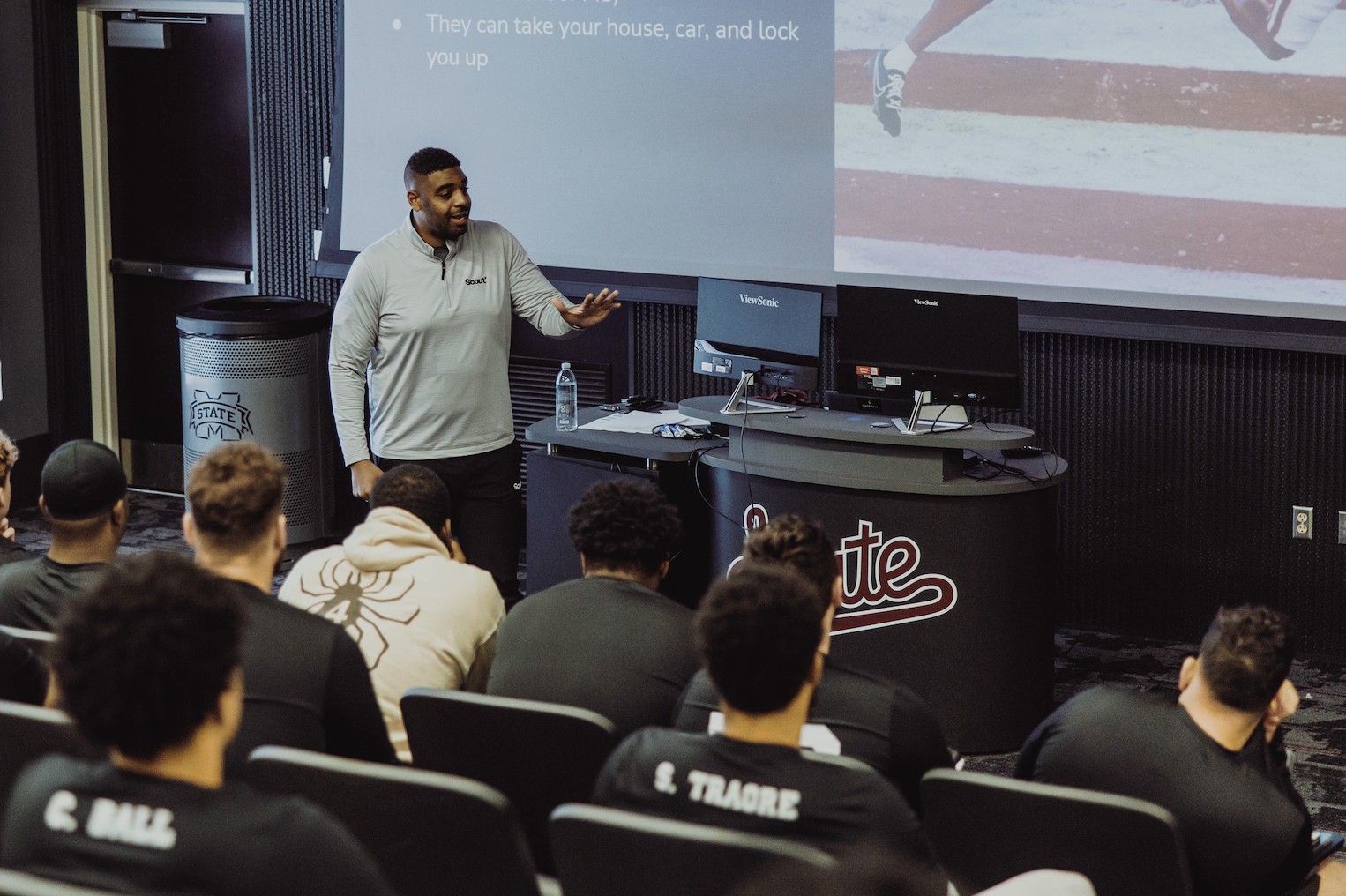
While lawmakers debate how to protect student-athletes' NIL earnings, Scout has spent the summer doing the work reaching 2,500+ athletes with hands-on financial education in a single month.
Washington, D.C. — The conversation about name, image, and likeness has entered a new phase. It is no longer only about how much college athletes can earn — it is about whether they are prepared to keep, grow, and protect what they make. That question has moved from locker rooms to the halls of Congress and state legislatures, and it is quickly becoming one of the defining policy issues in college sports.
Scout, a financial technology company built by athletes for athletes, is not waiting for the debate to conclude. In July 2026 alone, the company:
- Completed 19 summer onsite visits to athletic programs
- Delivered more than 55 presentations to teams and departments
- Provided financial education to more than 2,500 student-athletes
That work extends beyond individual campuses. Scout recently took part in Morehouse 360: The Launch Pad, delivering financial education to student-athletes as part of a broader push to put their financial futures first — an effort championed by Scout investor and 12-time NBA All-Star Chris Paul, who is working to bring more of this programming to college campuses. It is the first step in a deeper commitment to Morehouse and HBCU athletes, with more to come.
It is the kind of boots-on-the-ground work that turns policy conversations into practice and few, if any, are doing it at this scale. Scout also brought that field experience to Washington this summer. Scout’s tax expert, Thad Madden, testified before the House Ways and Means Committee this summer, and the company continues to meet with members of Congress — bringing firsthand insight from the field into the rooms where policy is being written.
The need is well documented. In a 2022 NCAA survey of more than 9,800 athletes, roughly half said they wanted educational resources on taxes and financial literacy, while only 9 percent had ever met with a financial counselor. In the years since, NIL earnings have grown into a multibillion-dollar marketplace, with deals projected to exceed $2.5 billion by the 2025–26 academic year as revenue sharing takes hold. The gap between what athletes are earning and what they have been taught to manage has never been wider.
Lawmakers have noticed. In Washington, the bipartisan HUSTLE Act — introduced in both the House and the Senate — would create tax-advantaged accounts to help athletes invest their NIL income and build long-term security, with financial literacy written into its purpose. In California, state legislators have advanced a proposal to require a recurring financial-literacy curriculum for NIL athletes, covering everything from taxes and budgeting to fraud and long-term planning. The message from both parties and multiple statehouses is converging: if athletes are going to earn, they must also learn.
"The country is finally saying out loud what we built Scout to solve," said Michael Haddix Jr., CEO and Founder of Scout. "Financial literacy for athletes isn't a nice-to-have anymore. It's becoming law. But policy sets the floor; it doesn't do the work. Someone still has to show up on campus, sit down with a room full of eighteen-year-olds, and teach them how a tax bill and an LLC actually work. That's what we've been doing all summer, and it's what we'll keep doing whether or not a bill passes."
Scout's model pairs technology with human contact: a platform that helps athletic departments manage revenue-share distribution and compliance, an athlete-facing app for taxes, savings, LLC formation, and long-term planning, and critically in-person education delivered on campus, program by program.
"You cannot text a teenager a PDF and call it financial literacy," Haddix said. "The programs that are getting this right are the ones putting people in the room. That's the standard, and we intend to keep setting it."
As the federal and state frameworks take shape, Scout's position is straightforward: the infrastructure athletes need should not wait for legislation to catch up. It should be built now — one campus, one presentation, one athlete at a time.
Book a call to learn more about Scout and our full suite of financial services.
About Scout
Scout is an innovative financial technology company built specifically for athletes. Combining education, one-on-one support, and a mobile app, Scout helps student-athletes navigate taxes, savings, LLC formation, and investment planning. Its customizable revenue distribution platform serves athletic departments, coaches, and athletes in today's evolving college sports environment. Scout looks at NIL differently — Name, Image… Lifetime.



.png)
